About the Program
*NY Seal of Civic Readiness Approved*
Registration for the 2026-27 SY NOW OPEN!
Quality of Life INNOVATIONS (QLI) is a unique social entrepreneurship initiative that fosters a spirit of civic engagement and social innovation among high school students, while helping them prepare for college. Students identify a community issue they care about, conduct primary and secondary research to examine the issue and develop and implement feasible proposals for change. Proposals can compete for college scholarships.
Sign Up for QLI Newsletters Volunteer
Request More Information
How QLI works
Students from each participating school work either individually or in teams of up to three with support from a teacher. W!se provides a Student Handbook, Teacher’s Guide and Curriculum Toolkit, as well as webinars and workshops to help them prepare.
In April, students submit a college-level paper containing their analysis, findings, recommendations and implementation plan. The papers are judged and rated, with the top students/teams advancing to a final round, where they present their proposals in person to a panel of judges. Scholarship money is awarded to the top three students/teams; additional prizes go to the other finalists and semifinalists.
Seal of Civic Readiness and Portrait of a Graduate Alignment
The Quality of Life Innovations Proposal is approved under NYCDOE’s Civics for All Initiative as High School Civics Project 2a. This means that each student who successfully completes a QLI Proposal earns 1.5 points towards the State Seal of Civic Readiness.
Developing a Quality of Life Innovations Proposal is not an easy task, and through this initiative, students develop key college & career readiness skills. These skills align directly with the new Portrait of a Graduate initiative. See below:

2026 Winning Proposals
First Place was awarded to Rayyan Shafqat from Brooklyn Technical High School in Fort Greene for his proposal, “Arduino-based Carbon Monoxide Detection System with Automated Boiler Shutoff Mechanism,” that designed a low-cost carbon monoxide detection system to automatically shut off boilers, providing a reliable solution that reduces reliance on human response.
Carbon monoxide is a deadly, invisible gas that causes around 400 deaths and over 100,000 emergency visits each year in the United States, often due to heating system failures. This project introduces a low-cost device that detects dangerous CO levels and automatically shuts off a home’s boiler before conditions become life-threatening. The system is designed for easy, real-world implementation: it can be installed in about 10 minutes without modifying gas lines by using a small actuator to press the boiler’s existing emergency shutoff switch. It continuously monitors CO levels and triggers a shutdown if concentrations exceed 100 ppm for 30 seconds, ensuring both accuracy and safety. Testing supports its effectiveness, showing a small average error of about 5 ppm and a consistent response time of roughly 31 seconds. At a cost of about $27, the system is significantly more affordable than current solutions, and its non-invasive design makes it accessible to millions of households. With further improvements, this device could be scaled into a widely adopted safety solution that actively prevents carbon monoxide poisoning.
Second Place was awarded to Jiexi Pan, Joaquin Lago, and Anthony Ou from Staten Island Technical High School for their proposal, “Early Warning System for Combined Sewer Overflow,” that developed a low-cost sensor network that predicts sewer overflows by monitoring soil saturation and rainfall.
Early Warning System (CSO) addresses the environmental and public health risks caused by combined sewer overflow, where heavy rain leads to untreated sewage entering water systems. Current approaches mostly respond after overflow occurs, but this project focuses on predicting it in advance. Using a network of low-cost sensors, the system tracks rainfall and soil saturation, identifying a key threshold where overflow begins. Testing showed that overflow consistently occurred at around 30–31% soil moisture (VWC), providing a clear and measurable indicator of risk. By turning overflow into something predictable and data-driven, this system allows cities to target the specific areas contributing most to the problem, rather than relying on broad, expensive infrastructure fixes. The project demonstrates a practical and scalable way to shift from reaction to prevention in urban water management.
Third Place was awarded to Shehrin Habib, Sophia Llopis, and Angelina Belliard from Forest Hills High School for their proposal, “ArtReach: Connecting NYC Public High School Students with the Arts,” that created a free directory of arts institutions and a field‑trip model, addressing barriers like cost and awareness to increase student access to hands-on arts experiences.
ArtReach addresses the lack of access to arts experiences in NYC public high schools, where students show strong interest but limited opportunity to engage. Field research revealed that 78.6% of students want more arts resources, yet 47.5% report little or no engagement, and 41.8% go on zero field trips each year. To address this gap, the project created a digital directory of free and low-cost arts institutions, making it easier for teachers to plan trips and integrate the arts into learning. A pilot field trip was used to test impact, with post-survey results showing that over 90% of students experienced improved learning and emotional well-being, and 100% wanted more trips. With no cost to access and easy scalability across schools, this solution demonstrates how improving awareness and organization can significantly expand students’ access to arts education.
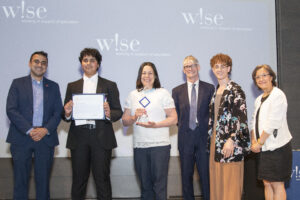
To view photos of the day, click here.
2025 Winning Proposals
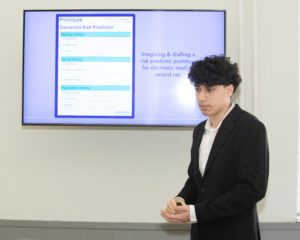
The 2025 First Place scholarship was awarded to Salahaldeen Ibrahim from Staten Island Technical High School for his proposal: “Peace of Mind: Piloting a Dementia Risk Prediction Tool”.
While dementia has devastating effects on individuals and families, early diagnosis remains elusive and expensive—especially for marginalized communities. To address this, Salahaldeen Ibrahim developed “Peace of Mind,” a machine learning model that predicts the risk of five dementia subtypes using routine clinical data already found in medical charts. Unlike costly genetic testing, this tool is accessible, scalable, and achieved over 85% accuracy during testing with a national dataset. He interviewed neurologists and researchers from Mount Sinai, all of whom emphasized the urgent need for earlier diagnosis tools, and one lab even piloted my prototype. The tool empowers patients and families to plan proactively, alleviates caregiver burden, and sets a new standard for compassionate neurological care. With continued testing and institutional support, this innovation could transform dementia prediction and improve quality of life nationwide.
Second place was awarded to Tamana Saini, Zoe Sharapov, and Jenny Ye from Forest Hills High School for their proposal: “Ready, Set, Safe: Creating Emergency Ready NYC Youth”.
Tamana Saini, Zoe Sharapov, and Jenny Ye developed “Ready, Set, Safe” to address the lack of emergency preparedness among children by creating a fun, multilingual lesson for NYC 4th and 5th graders. Partnering with EMTs, firefighters, and teachers, they taught 656 students life-saving skills like calling 911 and responding to medical emergencies. Pre-lesson surveys revealed major gaps in knowledge, but after the lessons, 92.6% of students felt more prepared. With strong support from educators and city officials, this low-cost, student-led program has the potential to scale citywide—empowering kids to respond confidently in emergencies.
Third place was awarded to Angel Mizhquiri, Anisa Akobirova, and Emily Padilla from Forest Hills High School for their proposal “S.H.E.L.L.: Students Helping English Language Learners”.
Angel Mizhquiri, Anisa Akobirova, and Emily Padilla developed “S.H.E.L.L.,” a peer tutoring program that tackles the academic and social challenges faced by ELL students (English Language Learners), many of whom struggle to graduate. After surveying over 120 ELL students, they launched S.H.E.L.L. with bilingual volunteers offering tutoring during and after school. The results were powerful: 100% of participants improved academically, and 80% felt more confident in class. Praised by faculty and city officials—and winning first place at the MyImpact Civics Fair—this zero-cost, scalable model strengthens school communities by supporting some of their most vulnerable students.
To view more photos, click here.
View More Past Winners“I really loved that exhilarating feeling when my partner and I finally saw the effects of our implementation. It took us an entire year’s worth of hard work until we were able to get our idea going. When we saw just how effective our implementation was, we were thrilled that we actually contributed to our community!” Rebecca, Staten Island Technical High School
“Research supports the Quality of Life INNOVATIONS program because it provides students with an opportunity to learn important skills that will support them in college and beyond. The students learn such skills as research, writing, and the importance of being civically engaged, with my favorite (and important part) being how the students implement their proposal.” Erin Baskett, Managing Partner and CFO/CCO of Autonomous Research, a sponsor of QLI